
Become certified in NVR for Brain-based Disabilities!
The Applied Training Program on Nonviolent Resistance for Brain-Based Disabilities is a four-day hybrid training designed for allied mental health professionals working with children, youth, and families experiencing complex developmental and behavioural challenges.
This program provides an adapted model of Nonviolent Resistance (NVR) that explicitly integrates neurodevelopmental science, trauma-informed care, and systemic practice. It is designed for clinical contexts in which standard behavioural or parenting approaches are insufficient or ineffective.
Choose Your Training Pathway
This certification offers two distinct pathways depending on your role and the type of support you provide to families. Both pathways are grounded in neuroscience, trauma-informed care, and Nonviolent Resistance adapted for brain-based disabilities and complex family systems.
Clinical Pathway - 18 Hours
Designed for clinicians, therapists, and professionals providing therapeutic or clinical interventions to families experiencing severe behavioural challenges.
This pathway focuses on:




Ideal for
Mental health therapists, Social workers, Psychologists, Counsellors and FASD workers.
What This Training Includes
This is a four-day applied training program combining live instruction and self-paced learning:
9 hours of asynchronous online learning
- 5 Pre-recorded modules
- Completed at the participant's own pace
- Hosted on a secure training platform
9 hours of live online training
- Three consecutive mornings
- Three hours per morning
- Delivered live by Dr. Maude Champagne
6-month follow-up group consultation with Dr Maude Champagne
- Two date options offered
- Case-based clinical discussions
- Integration of learning into real-world practice
Certification upon completion

Participants who complete all components of the program will receive a:
Certificate in Applied Nonviolent Resistance for Brain-Based Disabilities
Graduates will also be invited to continue their learning through a Community of Practice in
Canada, supporting ongoing clinical reflection, peer consultation, and professional
development.

Peer Support Pathway
- 12 Hours
This training is designed for peer support
workers, parent mentors, and individuals who
support families through lived experience
and community-based roles.
The program consists of 12 hours of training
delivered through a combination of live
instruction and specialized video modules. It
features peer-support-specific content,
including practical case examples to enhance
learning and real-world application.
Participants who complete the training will
receive a certificate of completion.
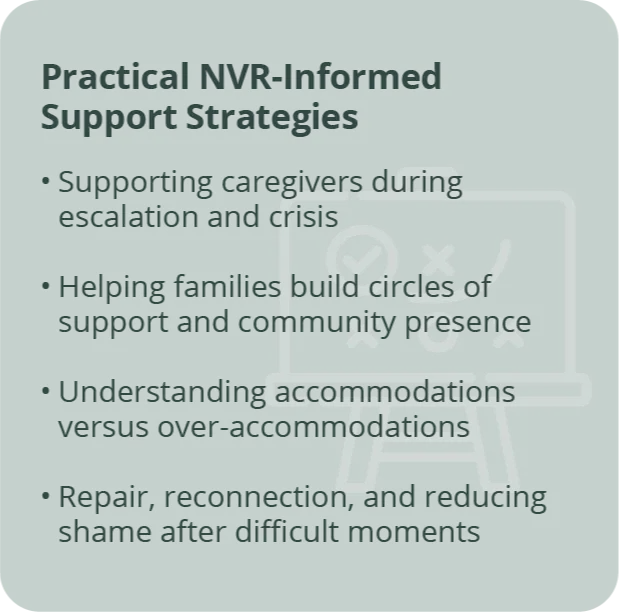
This pathway focuses on:


Ideal for

Supporting Families Through Presence, Connection, and Community
This training pathway is designed specifically for peer support workers, parent mentors,
family advocates, and individuals with lived
experience supporting caregivers raising
children and youth with complex behavioural,
developmental, or relational needs.
Grounded in Nonviolent Resistance (NVR),
neuroscience, trauma-informed care, and
brain-based disabilities, this program helps
peer supporters learn how to walk alongside
families in ways that reduce isolation,
strengthen caregiver resilience, and increase
safety without stepping into a clinical role.
Unlike traditional behaviour-focused
approaches, this training emphasizes
relational support, nervous system
awareness, validation, boundaries, and the
power of community presence.

What You Will Learn
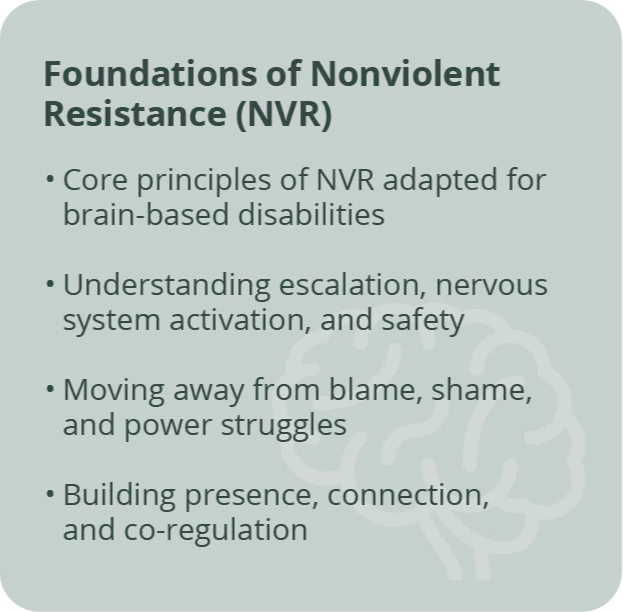
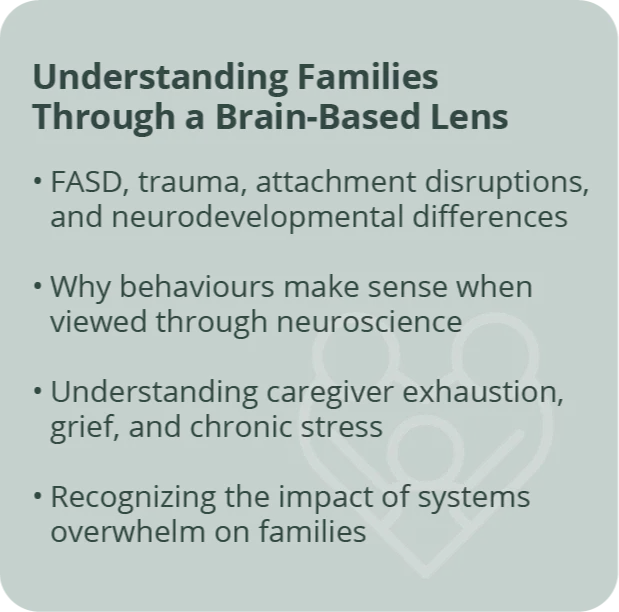
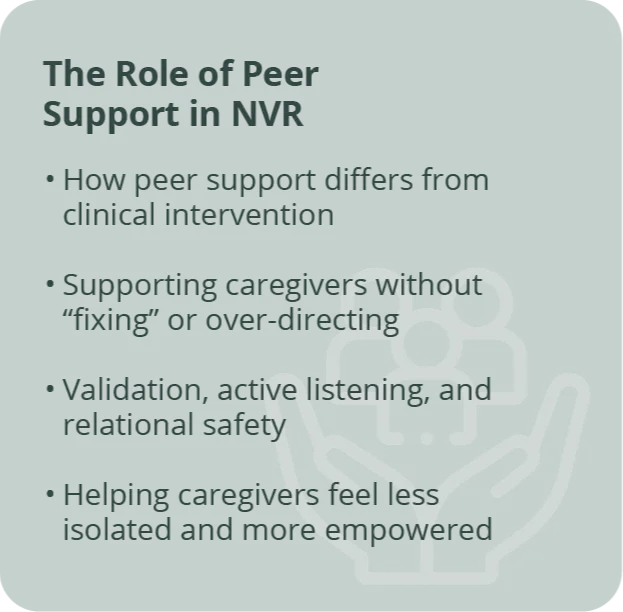
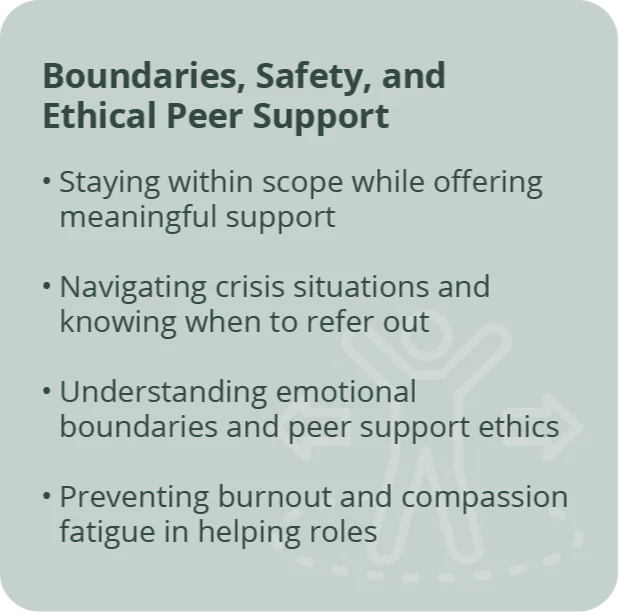
Learning Outcomes
By the end of this training, participants walk away with practical skills, deeper insight, and renewed confidence in their role. You will be equipped to clearly understand and apply the core principles of NVR, integrate peer-support-informed strategies with families, and support caregivers through a nervous-system-informed approach.
This training also strengthens your ability to recognize the impact of trauma and brain-based disabilities on behaviour, maintain healthy boundaries, and provide meaningful validation so caregivers feel supported and less alone.
Ultimately, you’ll be prepared to play a vital role in fostering safer, more collaborative family and community systems.